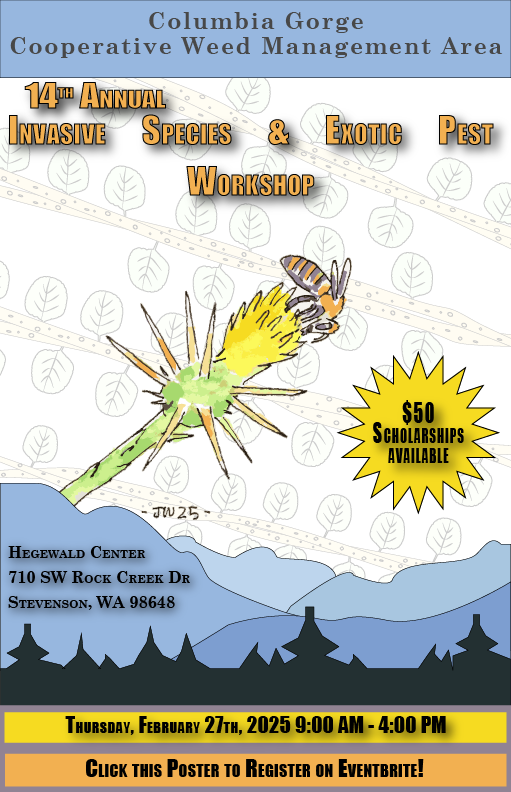
Join your friends and colleagues for ISEP in the beautiful Columbia Gorge!
The Columbia Gorge Cooperative Weed Management Area (CWMA) is once again hosting the 14th Annual Columbia Gorge Invasive Species and Exotic Pest Workshop! This opportunity is designed to provide information on invasive species management to land managers and the interested public. We are excited to be once again hosting the event in person at Skamania County’s Hegewald Center! The event agenda is posted below.
Please note:
- Lunch will not be provided at the event, so please bring a lunch or plan on eating at one of Stevenson’s local restaurants during the break.
- On the day of the event, please park behind the Hegewald Center near the Skamania County Fairgrounds; parking is not allowed in the front of the building.
- There will be no refunds issued due to inclement weather. Attendees can receive refunds up to one week prior to the event date.
Offered Recertification Credits
Oregon Department of Agriculture (ODA) – 4 Credits
Washington State Department of Agriculture (WSDA) – 4 Credits
Disclaimer: Any and all materials, presentations, or discussions pertaining to pesticide use or safety should be considered non-technical in nature and should not be construed as advice. Anyone using or planning to use any pesticides is responsible for their actions and should review and follow all label recommendations at all times.
We hope to see you there!
AGENDA
2025 Invasive Species and Exotic Pest Workshop
Thursday, February 29, 2024, 9:00am – 4:00pm
Hegewald Center
710 SW Rock Creek Drive, Stevenson, WA, 98648
9:00 – 9:10 Welcome
Hannah Brause, WSU Extension
Bio: Hannah Brause is an Associate Professor in the Community and Economic Development Unit of Washington State University. Hannah’s key areas of focus include Agricultural Educations, Food Systems, and Community Leadership. In addition to her faculty appointment Hannah Brause has also served as the County Director of Skamania and Klickitat County. Hannah shared that it has been a privileged to serve as the EMCEE for the Gorge ISEP program because of the fantastic line up of speakers providing an excellent learning opportunity, as well as the opportunity to network with others passionate about natural resource work.
9:10 – 9:20 Columbia Gorge CWMA Update
Brendan Fordyce, Clackamas SWCD
Bio: Brendan Fordyce received his BS in Ecology at Seattle Pacific University before entering into natural area restoration. He has also received a graduate certificate in Forests and Climate Change from Oregon State University and can often be found in the Mt. Hood National Forest killing weeds for Clackamas SWCD, hiking, foraging, or taking pictures for his iNaturalist page. He is also your CWMA coordinator!
9:20 – 9:30 Western Invasives Network Update
Courtney Gattuso, Western Invasives Network
Bio: Courtney is the Coordinator of the Western Invasives Network, housed with Cascade Pacific Resource Conservation & Development. In this role, she provides support to our CWMAs, working groups, and noxious weed agencies in western Oregon and southwestern Washington. For much of her career, she has worked in natural resource management with various public entities to pursue her passion for conservation. She studied Environmental Science and Geography at San Francisco State University and previously coordinated the 4-County and Columbia Gorge CWMAs.
Abstract: A brief update from the Western Invasives Network.
9:30 – 10:00 The Sams Walker Project: The Restoration of an Ecosystem for Pollinators
Dr. Sandra Haigh, Center for Ecodynamic Restoration
Bio: BS Wildlife Biology, Washington State University; MS Biology, Texas A and M University; PhD Biology, University of Nevada, Las Vegas. Professor Emeritus Clark College, Vancouver, WA; Research interests include the effects of invasive plants on native plant, insect, and vertebrate populations. Current President of the Center For Ecodynamic Restoration (CEDR) and Manager of CRG projects.
Summary: The Sams Walker Day Use Area is located in the Columbia River Gorge and is a public use area owned and managed by the USFS. In 2017, CEDR, in partnership with the USFS and several other organizations, began restoring the former farm to remove non-native vegetation and replace it with native plants with an emphasis on increasing pollinator habitat. This presentation summarizes the work to date.
10:00 – 10:15 Break
10:15 – 10:30 Oregon Regulatory Updates
Troy Abercrombie, Oregon Department of Agriculture
Bio: Based in Oregon, Troy serves as the Program Manager for ODA’s Noxious Weed Control Program and ODA’s Native Plant Conservation Program.
Summary: This presentation will highlight recent updates to Oregon’s Noxious Weed Control Policy, including new plant listings and recent de-listings. The presentation will also give an update on changes within the program and where attendees can seek technical assistance from ODA staff.
10:30 – 10:45 WA State Noxious Weed Control Board Updates
Mary Fee, Washington State NWCB
Bio: Mary went to Eastern WA University majoring in Biology and minoring in Environmental Chemistry. She began her noxious weed career as the Noxious Weed Coordinator for Ferry County, followed by serving as a Noxious Weed Specialist in King County. Mary has been the Executive Secretary for the WA State Noxious Weed Control Board since 2018. She enjoys working on her farm and exploring the great outdoors.
Abstract: The Washington State Noxious Weed Control Board update includes information about newly listed noxious weeds, the noxious weed listing process, and integrated pest management.
10:45 – 11:15 Utilizing Grass Specific Herbicide to Naturally Regenerate Emergent Wetlands and Promote Native Herbaceous Species in Riparian Plantings
Blaine Kisler, Clark County
Bio: Oregon State University, B.S. Forest Management with Ecosystem Science option. Noxious weed control, wetland/riparian restoration, forest management professional since 2011. With Clark County Since 2014.
Summary: Stands of reed canary grass that are fully established in wetland and riparian areas can take 5-7 years of control effort to fully reverse an invasion. Given current restoration grant funding timelines, this time commitment is typically not feasible for most restoration agencies and landowners. By utilizing a mix of cultural, mechanical, and chemical IPM methods, the work described in this presentation shows promise for the natural regeneration of emergent wetlands in areas with native seed bank or adjacent native plant communities to aid in propagule dispersal. By switching from a broad-spectrum herbicide, like glyphosate, to the grass specific herbicide clethodim, the native seed bank and colonization of native emergent species is allowed to thrive while in the process of fully exhausting energy reserves in RCG rhizome over several years through repeated mowing, flooding, and herbicide treatments. In this way, clethodim not only works as targeted chemical control, but also cultural control through promoting competing native vegetation. Clethodim is also a useful tool for improving native species coverage in old restoration sites that have been reinvaded by RCG, or early phases of woody plant establishment to increase colonization rate of woody vegetation while promoting a robust and diverse native herbaceous layer.
11:15 – 11:45 Establishing a Rotating Road-side Spray Operation
Harrison Hapgood, Wilbur-Ellis
Bio: Harrison received a Biology Degree from Colorado Mesa University, Worked as a forestry contractor for 6 years before switching to Hood River County’s Forestry Department worked there for another year managing their herbicide program before coming to work for Wilbur Ellis as the Vegetation Management Specialist for the state of Oregon and south west Washington for a little over a year and a half.
Summary: The presentation will cover what to expect when you start rotating the years you spray ROW areas and what type of herbicides will be of value when switching to this type of application.
11:45 – 12:00 Lightning Round
11:45 – 11:50 EZ-Ject Lance Basics
- Bio: Ethan Coggins is a Natural Area Specialist for Washington Department of Natural Resources. Ethan has also served on the Columbia Gorge CWMA Education and Outreach Committee as well as Steering Committee for over a year.
- Summary: This talk will be a quick overview of this IPM tool, how to use it, and when it is most appropriate.
11:50 – 11:55 Controlling Bullfrogs & Blackberries for Endangered Turtles
- Bio: Sara has worked for Friends of the Columbia Gorge since 2015, as the stewardship program manager. Sara takes a lead role on stewardship and restoration of Friends of the Columbia Gorge Land Trust preserves. She has been working in the natural resource field for over 20 years and has a diverse background in researching birds, fish, butterflies, plants, and forest carnivores. Studying in the east coast, where she grew up, she acquired degrees in ecology and environmental science; intrigued by the snow-capped mountains and never-ending beauty of the west Sara settled in the Gorge in 2003. She completed a master’s degree in environmental management at Portland State University where she researched the Oregon silverspot butterfly. In her free time, Sara loves to adventure with her family and friends—attempting to squeeze every drop out of life through rafting, skiing, camping and mushroom hunting, and enjoying the phenomenal food and drinks of the Pacific Northwest.
- Summary: American bullfrogs and Himalayan blackberry, both non-native, have dominated Northwestern Pond turtle habitat on the Friends-owned Turtle Haven preserve. Friends of the Columbia Gorge partnered with state and federal agencies to manage bullfrogs and invasive weeds to improve turtle habitat at their preserve and on the adjacent federal lands. Come hear the slimy highlights of this project in five minutes or less!
11:55 – 12:00 Camp Creek Fire: Post-Fire EDRR
- Bio: Angie Kimpo is the Co-Chair for the Columbia Gorge Cooperative Weed Management Area. Angie has worked for the Portland Water Bureau since 2009 as the Vegetation Stewardship Manager. Her work is focused on invasive species and vegetation management in the Bull Run Watershed, Sandy River Watershed and the City of Portland. She has worked in the field of restoration ecology in Western Oregon for the past 25 years.
- Summary: Portland Water Bureau staff and contractors implemented an early detection and rapid response program during 2024 within the Camp Creek burn area as part of the Forest Service BAER work. We will present on priorities and initiatives undertaken during that work in an area where herbicides cannot be used and other IPM methods were utilized.
12:00 – 1:30 Lunch On your own
1:30 – 2:00 Invasive Species Quiz
Kimberly Quayle, WA Department of Natural Resources
Bio: Kimberly is the eastside assistant ecologist for the Washington Department of Natural Resources Natural Areas program.
Abstract: An interactive quiz covering species identification. Questions will include classic “what species is this” questions, “early detection rapid response” questions about species distribution and species not yet in the area, and rapid fire “native vs. exotic” questions. A brief PowerPoint about the identification of each featured species will follow the quiz.
2:00 – 2:15 Lightning Talks
2:00 – 2:05 The Power of the CWMA
- Bio: Emily is the Skamania County Noxious Weed Program Coordinator and serves as the Gorge CWMA’s co-chair for both the steering and education and outreach committees.
- Summary: This presentation will discuss the logistics of treating emergent weeds on a world class whitewater river, focusing on techniques for safely and effectively using herbicide in an atypical treatment setting.
2:05 – 2:10 Roundleaf Bittersweet
- Bio: Brendan Fordyce received his BS in Ecology at Seattle Pacific University before entering into natural area restoration. He has also received a graduate certificate in Forests and Climate Change from Oregon State University and can often be found in the Mt. Hood National Forest killing weeds for Clackamas SWCD, hiking, foraging, or taking pictures for his iNaturalist page. He is also your CWMA coordinator!
- Summary: This presentation will cover known locations of this new pest, its biology, and methods of control.
2:10 – 2:15 A Virtual Introduction to Marsh Thistle
- Bio: Kimberly is the eastside assistant ecologist for the Washington Department of Natural Resources Natural Areas program.
- Summary: Recently listed as a class A noxious weed and only known from one location in Washington, marsh thistle is likely to be unfamiliar to many land managers, invasive species controllers, and noxious weed hunters. This introduction includes a quick species bio, identification tips, and control recommendations.
2:15 – 2:45 2024 Invasive Plant Pest Survey Results
Mariah Davis, USDA-APHIS
Bio: Mariah grew up in rural Oregon and received her bachelor’s degree in environmental science from Portland State University. She works in the Oregon State Plant Health Director’s Office, where she has been for 5 ½ years, and is responsible for planning and coordinating novel invasive plant pest surveys on behalf of APHIS in the state of Oregon. She also works closely with local partners conducting similar work by providing technical guidance and assistance navigating federal cooperative agreements to receive funding.
Summary: This presentation will summarize the 2024 results of annual surveys for novel invasive insects and plant pathogen pests conducted by the Oregon State Plan Health Director’s staff. In addition, the biology of several pests will be covered along with some potential management options. Plans for the 2025 survey season will also be discussed.
2:45 – 3:15 Afternoon Break
3:15 – 3:45 Powerlines and Pollinators in Greater Forest Park, Portland
Jina Sagar, Metro
Bio: For the past two years, as an Associate Natural Resources Scientist with Metro, Jina has been working on natural areas restoration in the Portland Metro area. Jina recently moved back to Portland from Wellington, New Zealand where she worked as an ecologist for seven years. Prior to New Zealand, she worked as a Research Scientist for the Lower Columbia Estuary Partnership and across Oregon as a wildlife biologist. Jina earned her B.A. in Environmental Science from Middlebury College in Vermont and her M.S. in Wildlife Ecology from Oregon State University.
Summary: There are miles of powerline corridors in the Metro area that could become connected pollinator habitat across the landscape. To reduce invasive weed species in the powerline right-of-way and install native shrubs and forbs with pollinator resources, Metro partnered with the utilities on three powerline pollinator projects. Jina will highlight these projects, one of which has been completed with the Bonneville Power Administration and the City of Portland.
3:45 – 4:00 Closing Remarks
Hannah Brause, WSU Extension
 Columbia Gorge